Motor and generator winding
Compact windings under high temperature, voltage and chemical exposure.
FLEX / WIRE / 04
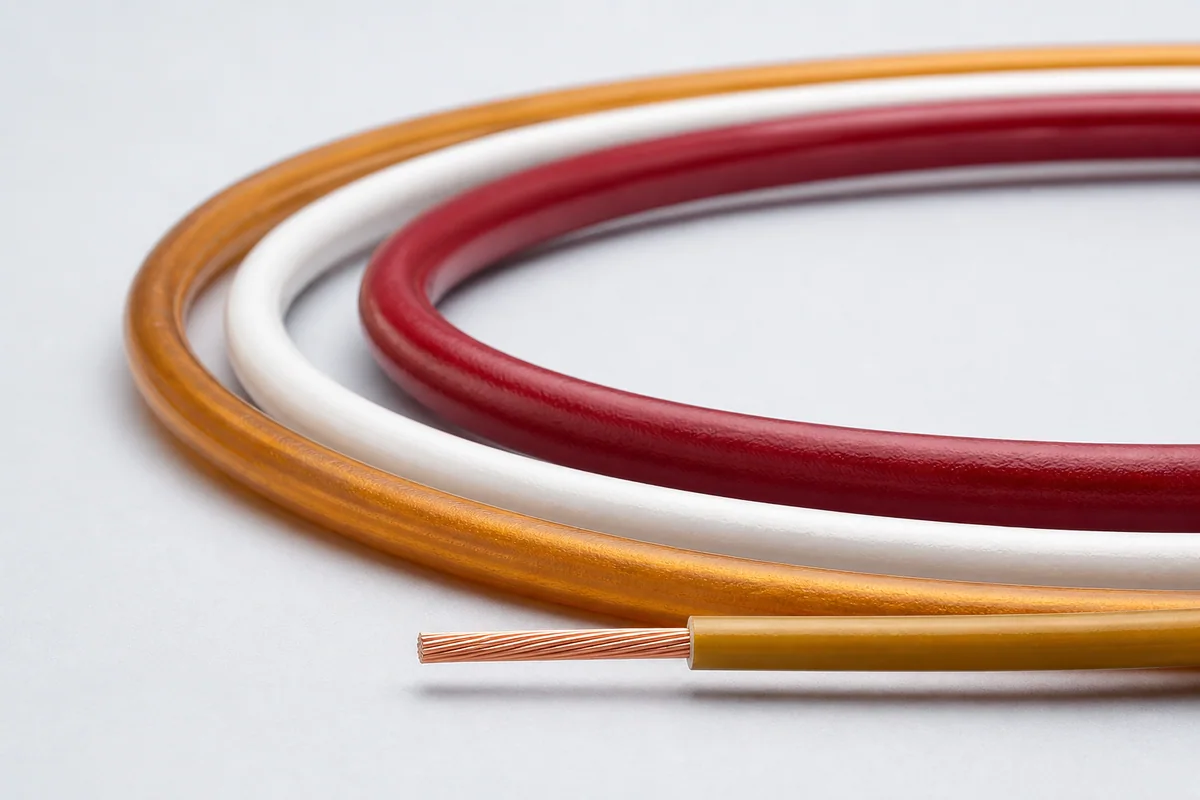
High-strength thin-wall fluoropolymer insulation provides a 300 °C thermal-class direction and hydrolysis resistance for downhole windings, sensors and high-temperature hook-up wiring.
01 / CONFIGURATION DIRECTIONS
These configurations establish a practical discussion starting point. The final product requires a controlled specification based on interface, length, installation and validation conditions.
Compact windings under high temperature, voltage and chemical exposure.
Small-diameter connection for real-time downhole data.
Preheat cable, tool power and internal control wiring.
Solution codes support early technical discussions by aligning protocol, construction, link boundaries and application in one view.
MODEL NOTEMaterial test values do not replace finished winding or cable validation; conductor, insulation wall, termination and thermal environment must be assessed together.
02 / PERFORMANCE PARAMETERS
The following values describe current product performance boundaries, with the applicable model, construction or test condition retained.
High-temperature downhole direction
Film material
ASTM D150
23 °C
289 °C
1500 h exposure at 98 °C
ASTM D1676 direction
Comparison data use bare copper conductors with thin-wall insulation; tensile strength and dielectric constant are film-material results.
03 / TYPICAL CONSTRUCTION
Size and surface are selected for winding, flexibility, resistance and high-temperature duty.
Electrical, abrasion, hydrolysis and chemical protection are delivered at small diameter.
Supports windings, sensors, thermocouples, hook-up wiring or high-temperature cable units.
Twists, shielding or outer protection are added for signal, power and downhole EMI conditions.
Solder, crimp, winding lead-out and thermal-cycle interfaces are controlled.
04 / SELECTION & VALIDATION
Motor winding, sensor, thermocouple or high-temperature hook-up
Voltage, current, dielectric constant, breakdown and signal integrity
Continuous temperature, hot spots, cycles and exposure time
Water, steam, acid, oil, methane and hydrogen sulfide
Wire diameter, bend, winding tension, scrape and tensile load
Coil, terminal, connector, shield and outer cable jacket
Material test values do not replace finished winding or cable validation; conductor, insulation wall, termination and thermal environment must be assessed together.
Ready to define a controlled specification?
Yidong Telecom can build a sample direction and validation matrix around the cable construction, termination and system boundaries.
Submit requirement checklist ↗