Fatigue-life direction
Reduce cyclic damage through stranding, material modulus and stress distribution.
FLEX / 02
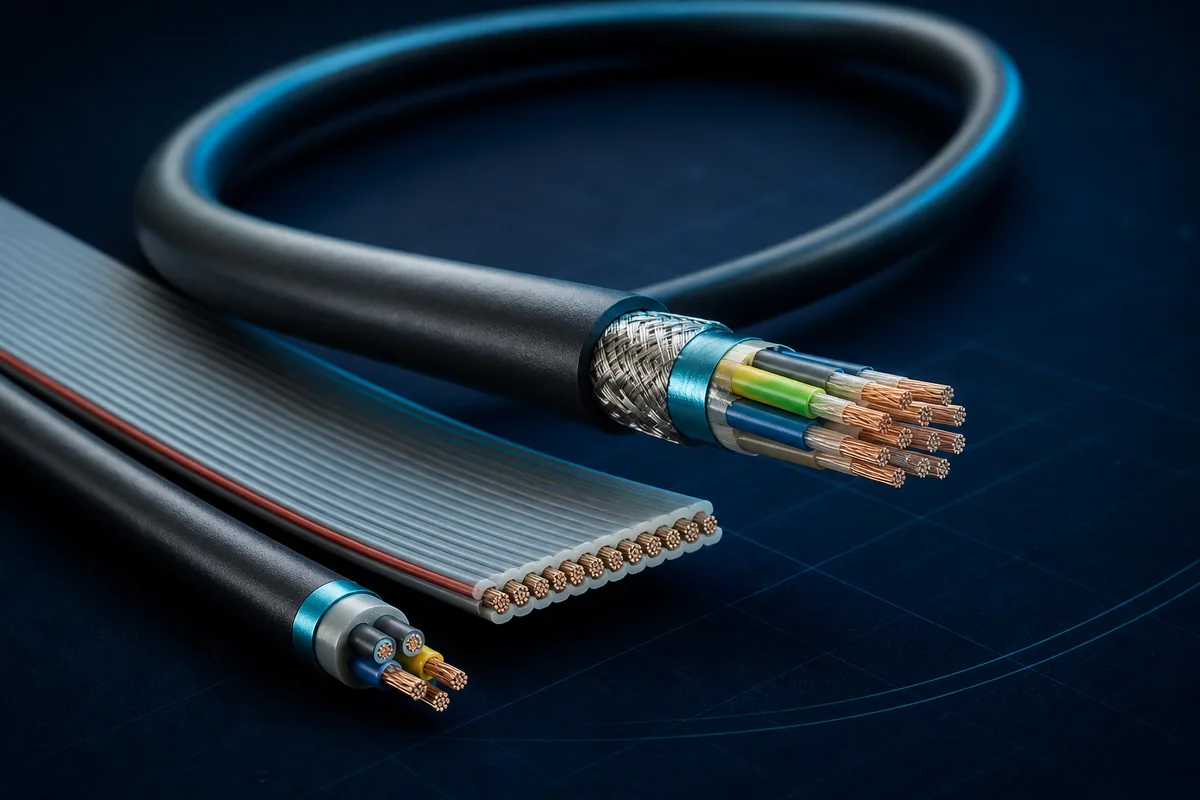
Continuous-flex, torsion and tight-routing cable systems for robotics, machine vision and automated equipment, using fine-stranded conductors, low-stress constructions, fatigue-resistant insulation and low-friction jackets.
01 / PRODUCT OVERVIEW
This information supports product direction and early technical discussions. Yidong Telecom defines final materials, dimensions and manufacturing around the actual interface, environment and validation target.
Reduce cyclic damage through stranding, material modulus and stress distribution.
Manage conductor migration, ovalization and localized stress in compact spaces.
Maintain impedance, shielding and termination geometry during motion.
Match jacket surface and construction to stroke, speed and guidance.
02 / PRODUCT TYPES
Each type must be further defined by protocol, length, installation and environmental conditions. A category name is not a fixed specification.
Low-profile parallel constructions for controlled planar motion and compact installation.
View specific product ↗Data, control, video, pneumatic or power units combined in one jacket to reduce moving cable count.
View specific product ↗Fine-stranded, fatigue-resistant building blocks for dynamic harnesses and assemblies.
View specific product ↗Controlled-motion systems without conventional cable carriers, evaluated around sag, guidance, speed and acceleration.
View specific product ↗03 / ENGINEERING DESIGN
Fine-stranded bundles optimized for resistance, flexibility and fatigue.
Low-modulus, abrasion-resistant polymers with the required electrical properties.
Data pairs, coax, fiber and power elements arranged around stress and neutral-axis behavior.
Tapes, fillers and shields manage internal friction and conductor movement.
Configured for carrier, free-flex or torsional motion.
04 / SELECTION & VALIDATION
Flex, torsion or combined motion
Stroke, speed, acceleration and cycle frequency
Installed bend radius and free length
Signal, power and pneumatic mix
Jacket friction, cleanliness, vacuum and ESD
Target cycles and validation conditions
Flex life depends on radius, stroke, speed, temperature, load and installation. Samples must be validated against the actual motion profile.
Ready to turn a product direction into a controlled specification?
Prepare protocol, electrical, mechanical, environmental, interface and validation requirements so we can define the material, construction and sample-validation path.
Return to requirement checklist ↗