Impedance & delay
Control conductor geometry, dielectric layers and twist to reduce discontinuities.
DATA / 01
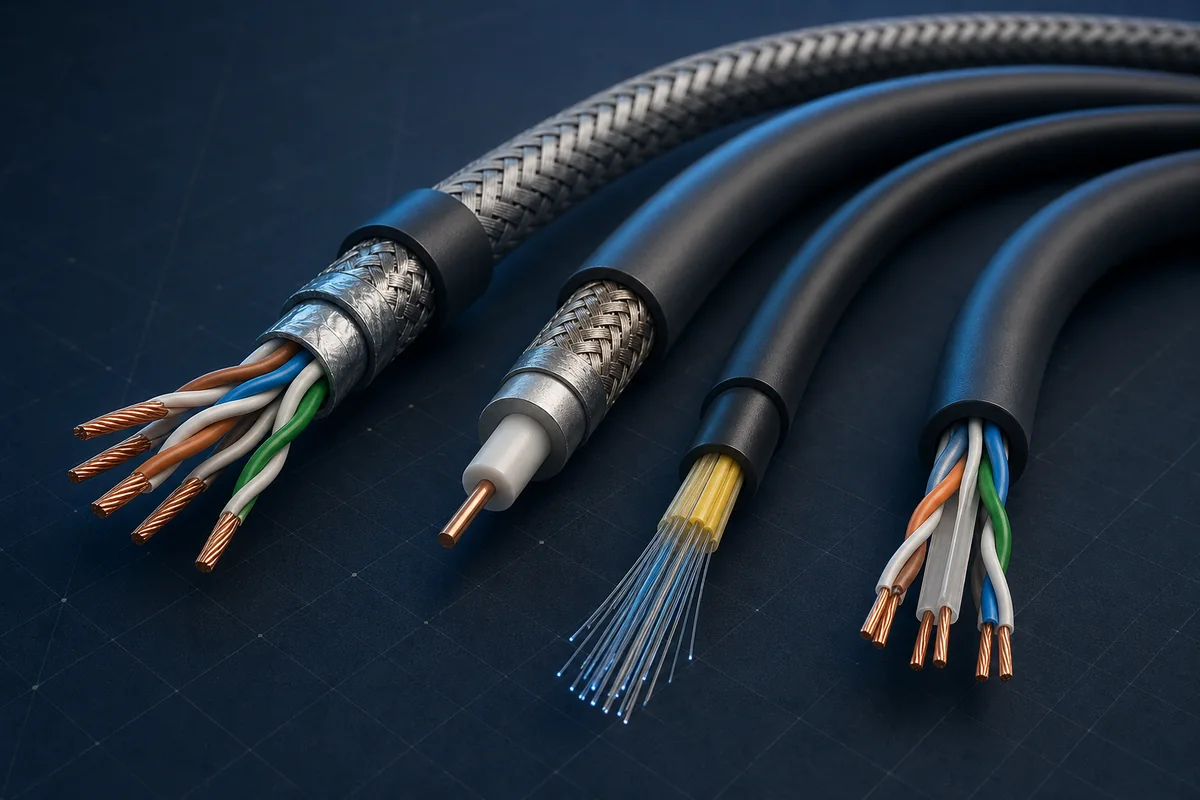
Digital interconnects for equipment and systems, co-engineered through conductors, insulation, twisting, shielding and jackets—from control buses to high-speed differential data, video and optical links.
01 / PRODUCT OVERVIEW
This information supports product direction and early technical discussions. Yidong Telecom defines final materials, dimensions and manufacturing around the actual interface, environment and validation target.
Control conductor geometry, dielectric layers and twist to reduce discontinuities.
Select pair shields, overall shields and grounding for the protocol and installation.
Balance diameter, copper content, mechanical strength and manufacturability.
Align cable construction, connector, strip dimensions and assembly process.
02 / PRODUCT TYPES
Each type must be further defined by protocol, length, installation and environmental conditions. A category name is not a fixed specification.
Controlled-impedance links for industrial and vehicle networks, with emphasis on common-mode noise and routing stability.
View specific product ↗Concentric controlled-impedance paths for clock, video, RF or sensitive single-ended signals.
View specific product ↗Multichannel differential construction and overall shielding for digital video equipment interconnects.
View specific product ↗Equipment and system Ethernet links tailored around data rate, length, flexibility and environment.
View specific product ↗Optical transmission for EMI immunity, isolation, low weight or longer-distance links.
View specific product ↗High-reliability storage and data-network interconnects defined by termination, link budget and installation.
View specific product ↗IEEE 1394-class equipment interconnect direction combining differential data, power and shielding.
View specific product ↗Low-profile parallel constructions that improve routing efficiency and preserve conductor position.
View specific product ↗High-speed audio/video links with controlled differential pairs, crosstalk, shielding and termination.
View specific product ↗Symmetrical four-conductor constructions for noise rejection, flexibility and compact balanced links.
View specific product ↗Twist and shield systems that reduce crosstalk and external EMI across differential protocols.
View specific product ↗Data-and-power interconnects designed around rate, length, flex and connector requirements.
View specific product ↗Low-particle, routable round-cable direction for clean environments and precision equipment.
View specific product ↗03 / ENGINEERING DESIGN
Solid or stranded copper-based conductors with plating selected for resistance, flex and strength.
A polymer system selected for impedance, dielectric loss, temperature and processing.
Twisted pair, quad, coaxial, optical or parallel-flat functional units.
Foil, braid or composite shields with fillers that stabilize geometry.
Defined around abrasion, flex, cleanliness, flame and connector assembly.
04 / SELECTION & VALIDATION
Protocol, target data rate or frequency
Characteristic impedance and tolerance
Link length, connectors and transitions
Maximum diameter, weight and bend radius
Static, occasional-flex or continuous-motion use
Temperature, flame, cleanliness, vacuum or chemical requirements
This page supports product-direction and solution discussions. It does not imply automatic compliance with any protocol grade or certification. Final construction and performance are governed by the approved specification and validation results.
Ready to turn a product direction into a controlled specification?
Prepare protocol, electrical, mechanical, environmental, interface and validation requirements so we can define the material, construction and sample-validation path.
Return to requirement checklist ↗