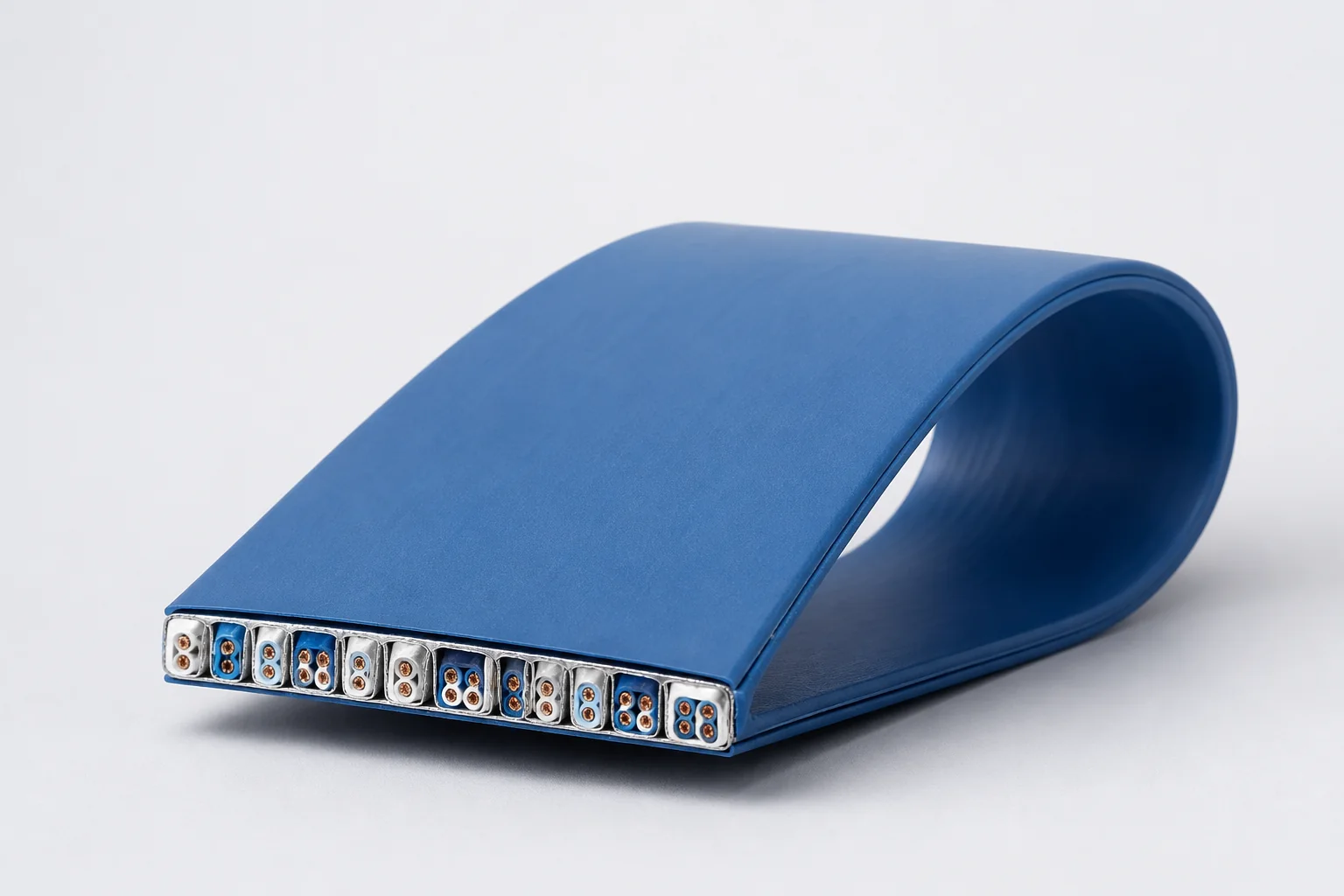
High-speed differential flat cable
Positions Ethernet or USB differential units to manage impedance, crosstalk and dynamic skew.
DATA / FLAT / 06
High-speed flat data cable for semiconductor and precision-motion equipment, supporting directions through 1 GHz and Ethernet, FireWire, USB and CoaXPress with more than 10 million flex cycles at a 50 mm dynamic bend radius and an ISO Class 1 cleanroom direction.
01 / CONFIGURATION DIRECTIONS
These configurations establish a practical discussion starting point. The final product requires a controlled specification based on interface, length, installation and validation conditions.
Positions Ethernet or USB differential units to manage impedance, crosstalk and dynamic skew.
Integrates CoaXPress or other camera-signal units while preserving geometry through repeated travel.
Combines FireWire, control or low-voltage power units to reduce cable count on moving stages.
Solution codes support early technical discussions by aligning protocol, construction, link boundaries and application in one view.
MODEL NOTESolution codes support early protocol, motion and cleanliness matching. Final part number, flat dimensions, channel layout, termination and life conditions are confirmed against equipment stroke and test specification.
02 / PERFORMANCE PARAMETERS
The following values describe current product performance boundaries, with the applicable model, construction or test condition retained.
High-speed flat data cable
Standard test condition
Dynamic bend condition
Cleanroom application configuration
Cable-construction dependent
Flex life and cleanliness are affected by stroke, bend radius and acceleration and should be validated against the application.
03 / TYPICAL CONSTRUCTION
Parallel positions are defined from channel count, current and signal integrity.
Controls impedance while supporting a thin flexible profile.
Pair, zone or overall shields manage crosstalk and external noise.
Controls neutral axis, conductor migration and planar flex.
Supports equipment routing and selected cleanliness requirements.
04 / SELECTION & VALIDATION
Channel count, protocol, impedance and data rate
Pitch, width, thickness and bend direction
Stroke, radius, speed, acceleration and cycle target
Cleanroom class direction, particles, ESD and vacuum
Connector pitch, contact map and strain relief
Guide surfaces, free length, clamps and service access
Cleanroom class, flex life and protocol performance depend on materials, stroke, bend radius, speed and acceleration and require validation on the installed motion profile.
Ready to define a controlled specification?
Yidong Telecom can build a sample direction and validation matrix around the cable construction, termination and system boundaries.
Submit requirement checklist ↗